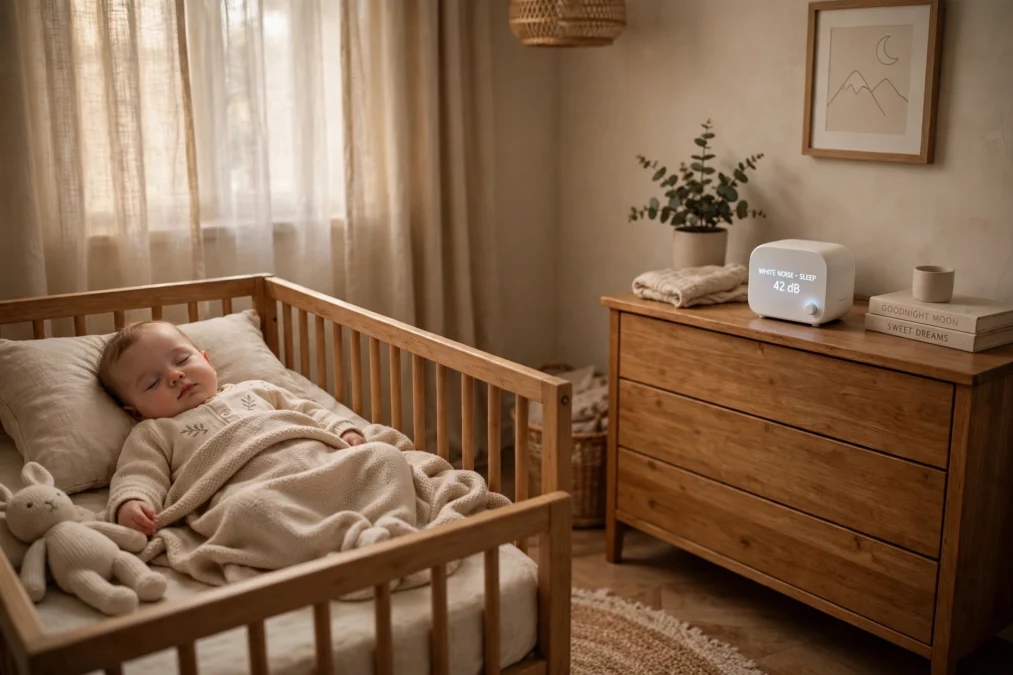
Yes, a white noise baby machine can help many babies settle more quickly, but only when it is used at a low volume, placed well away from the cot, and switched off after a limited time. White noise is a steady, even sound that masks sudden household noises, and a small study from 1990 found that babies fell asleep faster with it, although it is never a substitute for the basic rules of safe sleep. Parents should always place their baby on their back in a clear cot, keep the room at a comfortable temperature, and keep the machine outside the cot, because safety matters far more than any small gain in sleep. This guide explains what white noise is, how it works, how to use it safely, and when to ask a health visitor or GP for advice.
What Is White Noise and Why Do Babies Respond to It?
White noise is a consistent sound that contains many frequencies at a similar level, so it sounds like a steady hiss or the soft rush of a fan, and a white noise baby machine simply plays that sound at a controlled volume in the nursery. Babies often respond to it because the womb is a noisy place, full of the mother’s heartbeat, blood flow and muffled voices, so a newborn can find complete silence unfamiliar during the first weeks of life. A steady background sound can also cover up the sudden noises that wake a light sleeper, such as a closing door, a barking dog, or a sibling talking in the next room. Parents often notice that their baby settles faster when the sound is switched on, which matches the finding of a small 1990 study by Spencer and colleagues, published in the Archives of Disease in Childhood, that babies fell asleep faster with white noise.
The sound itself is not magic, and it does not teach a baby to sleep through the night on its own, so parents weighing up white noise baby sleep should see it as one small tool among several rather than a cure for broken nights. A calm bedtime routine, a dark room, a comfortable temperature and a regular sleep pattern all matter at least as much as any sound machine, and no machine can replace those basics. Some babies love the steady hiss from the first night, while others show no interest at all, and both reactions are normal because every baby has a different temperament. If your baby cries more when the machine is on, or seems unsettled by the sound, switch it off and try again another night or leave it out altogether. There is no rule that says every family must use white noise, and a baby who sleeps well without it needs nothing extra.
How White Noise Helps Babies Fall Asleep and Stay Asleep
A white noise baby machine helps at bedtime mainly by masking the sudden changes in sound that can wake a sleeping baby, because a steady background hiss makes a door closing or a car passing outside seem much less startling. Babies sleep in short cycles and stir briefly between them, so a familiar sound that stays constant through those light patches can help them drift back off instead of waking fully and crying for help. The 1990 study by Spencer and colleagues supports this idea, since the babies in that study fell asleep faster when white noise was playing than they did in silence. Parents also find that a machine gives them freedom to move around the house, because they no longer need to tiptoe past the nursery for fear of waking the baby with every small noise.
The benefit is usually modest rather than dramatic, so parents should keep their expectations realistic and not expect a machine to turn a wakeful baby into a long sleeper overnight. Sleep changes constantly in the first year as babies grow, learn new skills and go through phases of lighter sleep, so a tool that helped last month may seem less effective next month for reasons that have nothing to do with the sound itself. A machine works best as part of a steady routine, used at the same time each night alongside a bath, a feed, a story or a cuddle, because the routine itself becomes the signal that sleep is coming. If nights are still very difficult after several weeks, talk to your health visitor, who can look at the whole picture rather than just the sound in the room.
Is White Noise Safe for Babies?
White noise is considered safe for babies when it is used correctly, but the key words are low volume, good distance and limited time, because loud sound close to a baby’s ears is the real risk rather than the sound itself. The American Academy of Pediatrics (AAP) published a policy statement in November 2023, titled “Preventing Excessive Noise Exposure in Infants, Children, and Adolescents” and published in Pediatrics, volume 152, issue 5, which raised concern about excessive noise and the risks it poses to children’s hearing. The AAP advice on infant sound machines is clear in its essentials: place the machine as far from the baby as possible, set the volume as low as possible, and limit use to less than eight hours. Parents can read the AAP statement at aap.org for the full background on noise and children’s hearing.
Safe sleep rules matter just as much as volume, and the NHS safe sleep guidance reminds parents to place their baby on their back for every sleep, in a clear cot with no pillows, duvets or bumpers, in a room kept at 16 to 20 degrees Celsius, and in the same room as the parents for the first six months. A white noise machine must never be placed inside the cot, and it should never be hung on the cot bars or tucked beside the baby’s head, however small or soft it looks. The safest approach is to treat the machine as background sound for the room, not as something the baby listens to directly, and to keep checking that the volume still sounds quiet from the doorway. More detail on safe sleep is available from the NHS at cddft.nhs.uk. If you are ever unsure whether a sound is too loud, turn it down, because a quieter machine still masks household noise.
What Is the Safe Volume, Distance and Duration for White Noise?
The safest white noise baby setup is a quiet machine, placed a good distance from the cot, and switched off once your baby is settled or after a limited period, rather than playing loudly all night long. The AAP does not state a decibel number or a distance in its advice, so parents should know that the widely used practical targets of 50 decibels or below at the baby’s head, and the machine at least seven feet, or about two metres, from the crib, come from the hospital nursery noise limit and a 2014 study rather than from the AAP itself. Those practical targets are still useful, because they give parents a clear rule to follow: keep the sound at or below the level of a quiet conversation, and put real distance between the machine and the baby. A free decibel app on a phone can give a rough guide, but it is not a medical device, so use it as a check and trust your ears as well.
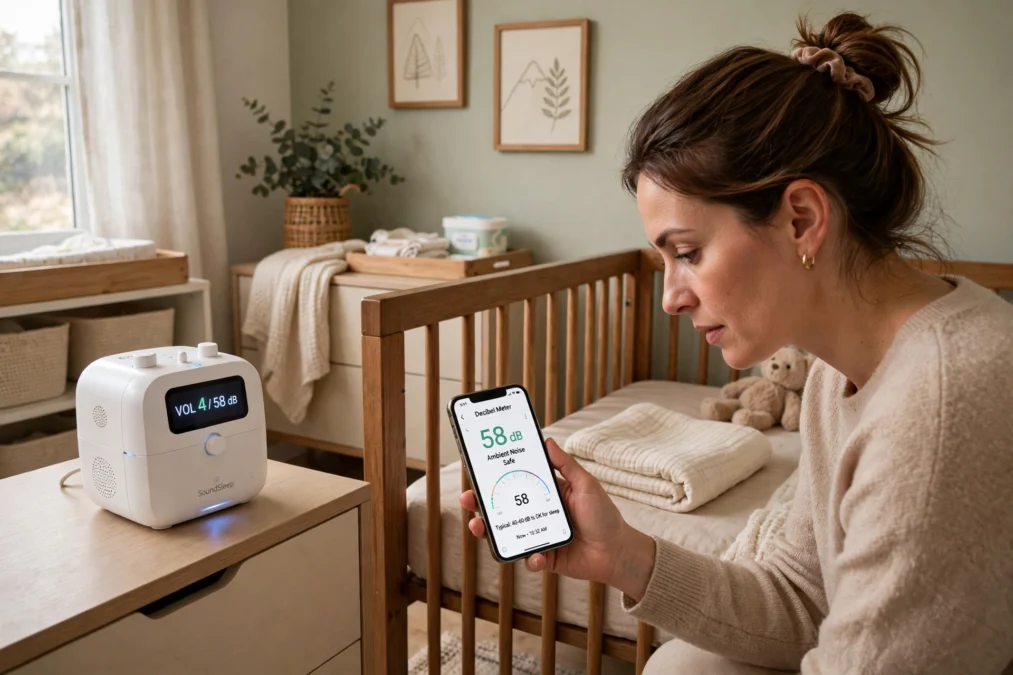
A 2014 study in Pediatrics by Hugh and colleagues tested 14 infant sleep machines and found that all of them exceeded 50 decibels at 30 centimetres when set to maximum volume, while three of them produced more than 85 decibels, which shows how easy it is to make the sound far too loud by accident. That is why the volume should be set low and the machine placed across the room, ideally near the door or on a dresser on the far side of the nursery. Duration matters too, so the AAP advice to limit use to less than eight hours means the machine should not simply run all night every night without thought. Many parents use a timer so the sound stops after their baby has fallen asleep, which also makes it easier to reduce the sound gradually later on.
White Noise vs Pink Noise vs Brown Noise: Which Sound Is Best?
White noise, pink noise and brown noise are all steady background sounds, and the difference between them is simply which frequencies are strongest, so white noise sounds like a high hiss, pink noise sounds softer and lower like steady rainfall, and brown noise sounds deeper still like a low rumble. Many parents find that the deeper sounds feel gentler on the ear, especially at low volume, while others prefer the brighter hiss of white noise because it covers sharp household sounds more effectively. There is no strong reason in the evidence given here to say that one colour is better than another for babies, so the honest answer is that the best sound is the one your baby settles with at a low volume. Trying each colour for a few nights is a reasonable way to find out, and the safety rules stay exactly the same whichever colour you choose.
The choice of sound matters far less than the volume, the distance and the duration, so parents should not spend money on a new machine simply because it promises a special colour or a special frequency. A simple white noise baby machine that plays one steady sound quietly and has a timer is often all a family needs, and extra features such as lullabies, heartbeat sounds or coloured lights are optional extras rather than essentials. Some babies are soothed by a fan or by the hum of a household appliance, which shows that the steady quality of the sound is what counts, not the label on the box. If your baby settles well with one sound, there is no need to keep changing it in search of something better, because consistency helps babies learn that the sound means sleep is coming.
Will My Baby Become Dependent on White Noise?
Many parents worry that their baby will become dependent on white noise and never learn to sleep without it, but this fear is usually greater than the problem itself, because a sound habit is far easier to change than most parents expect. Babies do learn to link a sound with sleep, which is exactly why the machine helps in the first place, yet that link fades quickly once the sound is reduced step by step over days or weeks. A gentle approach works best, so parents can lower the volume a little every few nights, then shorten the time the machine runs, and finally switch it off once the baby is asleep before stopping it altogether. If sleep gets worse for a night or two during the change, that is a normal part of adjusting, and most babies settle into the new pattern within a week or so.
There is no deadline by which a baby must sleep without white noise, so families should not feel pressured to stop at a particular age or to compare their baby with another child. Some children keep a quiet background sound for years without any harm, while others drop it naturally when they move to a bigger bed or a new room, and both paths are fine. The more useful question is whether the machine is still helping or whether it has become a source of worry, because a tool that causes stress is no longer doing its job. If you feel stuck, or if your baby seems unable to sleep at all without the sound, talk to your health visitor, who can help you plan a gentle change that suits your family.
When Should You Stop Using White Noise?
There is no single age at which every family should stop using white noise, so the decision is best made by watching your own baby and thinking about what is practical for your home. Many parents stop when their baby starts sleeping in a room of their own, when the household is quieter, or when the baby begins to settle without the sound on some nights, which is a clear sign that the habit is already loosening. Others keep a very quiet machine running for longer, especially if they live near a busy road or have older children who make noise in the evenings, and that is a reasonable choice as long as the volume stays low and the machine stays far from the bed. The key point is to review the setup from time to time rather than leaving the machine running loudly on the same setting for months without thinking about it.
Stopping is usually easiest when it is done gradually, by turning the volume down a little each week and then using a timer so the sound stops earlier in the night. A baby who is going through a change, such as teething, illness or a move to a new room, may need the familiar sound for a little longer, so it is sensible to wait for a calm week before making the change. Parents should also remember that sleep patterns change often in the first year, and a baby who wakes more for a while may simply be going through a normal phase rather than reacting to the loss of a sound. If you are unsure about timing, or if sleep problems carry on for several weeks, ask your health visitor or GP for advice rather than struggling alone.
Conclusion
A white noise baby machine can be a genuinely helpful tool for tired parents, but its value depends entirely on how it is used, with low volume, good distance and limited time being the three rules that matter most. The evidence shows that babies can fall asleep faster with a steady background sound, and the AAP advice from November 2023 gives parents a clear and simple framework for using machines without putting hearing at risk. Safe sleep always comes first, so a baby should sleep on their back in a clear cot, in a room at 16 to 20 degrees Celsius, with the machine kept well away from the cot and never placed inside it. Parents who follow those rules can use white noise with confidence, and they can stop it gradually whenever their family is ready.
Sleep in the first year is rarely smooth for long, and a machine that helped last month may seem less useful when your baby’s sleep suddenly changes, so it helps to read our guide to baby sleep regressions when a new phase begins. That guide explains why sleep often gets harder for a while and what parents can do while it passes, which is useful context alongside the sound advice in this article. If you are worried about your baby’s sleep, hearing or development at any stage, talk to your health visitor or GP, because professional advice that looks at your whole baby is always better than a general guide. With safe use and realistic expectations, white noise is simply one small way to make the nights a little easier for the whole family.
Is white noise safe for newborns?
White noise is safe for newborns when it is used at a low volume, placed as far from the cot as possible, and limited to less than eight hours, which is the advice given by the American Academy of Pediatrics in its November 2023 policy statement on preventing excessive noise exposure in infants, children and adolescents. Newborns have small and sensitive ears, so the volume should be kept low enough that it sounds quiet from the doorway, and the machine should never be placed inside the cot or close to the baby’s head. Parents should also follow the NHS safe sleep guidance, with the baby on their back in a clear cot, no pillows, duvets or bumpers, a room temperature of 16 to 20 degrees Celsius, and the baby in the same room as the parents for the first six months.
The practical targets that many parents use, of 50 decibels or below at the baby’s head and the machine at least seven feet, or about two metres, from the crib, come from the hospital nursery noise limit and a 2014 study rather than from the AAP, which does not state a decibel number or a distance in its advice. A 2014 study in Pediatrics by Hugh and colleagues found that all 14 infant sleep machines tested exceeded 50 decibels at 30 centimetres at maximum volume, and three produced more than 85 decibels, so setting the volume low matters more than the brand of machine. If you are unsure whether the sound is too loud, turn it down and move the machine further away, and ask your health visitor if you would like a second opinion.
Can white noise damage my baby’s hearing?
White noise can damage a baby’s hearing if it is played too loudly, too close to the baby’s ears, or for too many hours without a break, which is why the AAP raised concern about excessive noise in its policy statement published in Pediatrics in November 2023, volume 152, issue 5. The risk comes from the volume and the distance rather than from the sound itself, so a quiet machine placed across the room is very different from a loud machine sitting beside the baby’s head. A 2014 study by Hugh and colleagues showed how easily machines can become too loud, because all 14 machines tested exceeded 50 decibels at 30 centimetres at maximum volume and three produced more than 85 decibels. Keeping the volume low, the machine far away and the playing time under eight hours keeps the risk very low.
Parents can protect their baby’s hearing by setting the volume as low as possible, placing the machine as far from the cot as possible, and using a timer so the sound stops after the baby has fallen asleep. A phone decibel app can give a rough guide to the level at the baby’s head, but it is not a medical device, so it should be used as a check alongside common sense rather than as a precise measurement. If you ever notice that your baby does not respond to sounds, or you have any worry about their hearing, stop using the machine and speak to your GP or health visitor promptly, because early advice is always better than waiting.
How far away should the white noise machine be?
The machine should be placed as far from the baby as possible, which in most nurseries means on a dresser or shelf on the opposite side of the room, and never inside the cot or hanging from the cot bars. The AAP advice from November 2023 says to place the machine as far from the baby as possible, but it does not state a distance in feet or metres, so parents should not treat any single number as an official AAP rule. A widely used practical target is at least seven feet, or about two metres, from the crib, and that figure comes from the hospital nursery noise limit and a 2014 study rather than from the AAP itself. The further away the machine sits, the lower the sound level at the baby’s ears, which is the result that matters.
Distance works together with volume, so a machine that is far away can still be too loud if the volume is set to maximum, and a quiet machine that is close to the cot can still be a problem. The best check is to stand at the cot and listen, because the sound should be gentle and easy to talk over, and to check the level with a phone decibel app if you want a rough number. Parents should also keep the machine out of reach so that a curious baby cannot pull it into the cot as they grow and start grabbing objects. If your nursery is small and you cannot get much distance, keep the volume as low as you can and consider playing the sound from outside the room with the door slightly open.
Should white noise play all night?
White noise does not need to play all night, and the AAP advice from November 2023 is to limit use to less than eight hours, so most parents use a timer that switches the sound off after their baby has fallen asleep. Playing the sound only while the baby is settling, and for a short while afterwards, gives the masking benefit when it matters most, which is during the light sleep at the start of the night. Once the baby is in deeper sleep, the sound is less important, and switching it off also makes it easier to reduce the habit gradually later on. A machine that runs loudly for ten or twelve hours every night is not following the guidance, even if the volume seems low.
Some parents do leave a very quiet machine running for longer, especially in a noisy home, and that can be a reasonable choice if the volume is genuinely low and the machine is far from the cot. The important thing is to make a deliberate decision rather than leaving the machine on by default, and to review the setting every few weeks as the baby grows. If you use a timer, set it for the settling period first and then shorten it step by step over several nights, which is a gentle way to move towards silence. If sleep gets worse when the sound stops, talk to your health visitor, who can help you work out whether the sound, the routine or something else is the real issue.
What should I do if my baby only sleeps with white noise?
If your baby only sleeps with white noise, the first step is not to panic, because a sound habit is common and it can be changed gently over days or weeks without leaving your baby to cry alone. Start by lowering the volume a little every few nights, so the sound becomes quieter so gradually that your baby barely notices the change, and then shorten the time the machine runs by using a timer that stops earlier each night. Keep the rest of the bedtime routine exactly the same, with the same bath, feed, story or cuddle in the same order, because the routine itself becomes the new signal for sleep as the sound fades. Most babies adjust within a week or so, although a night or two of lighter sleep during the change is normal and not a sign that the plan has failed.
If the habit feels very strong, or if your baby seems unable to sleep at all without the sound, ask your health visitor for help in planning a gentle change that suits your family. It is also worth checking whether something else is making sleep harder, such as a room that is too warm or too cold, a cot that is not comfortable, or a routine that has drifted later in the evening. Parents should remember that there is no deadline for stopping, and that some children keep a quiet background sound for years without any harm, so the goal is a calm and rested family rather than a particular date. If you are worried about your baby’s sleep or development, speak to your GP or health visitor rather than struggling alone.