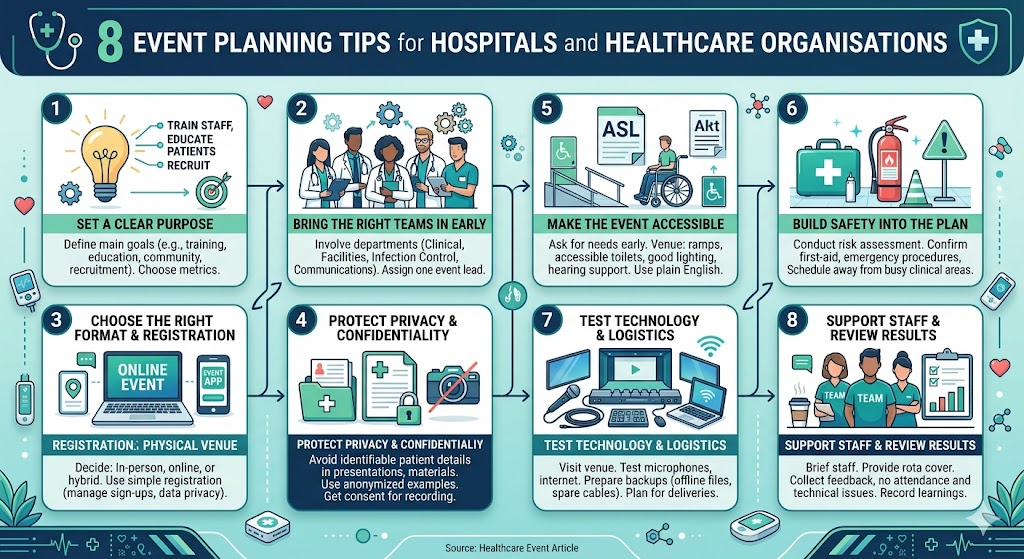
Planning an event in a healthcare setting comes with extra pressure.
You may be organising a staff training day, patient workshop, recruitment event, community health campaign, or clinical conference. Alongside the usual venue and speaker decisions, you must consider patient privacy, accessibility, infection control, staff rotas, and the impact on normal services.
A clear plan helps you protect patient care while giving attendees a useful and welcoming experience.
Here are eight practical tips to help you get it right.
1. Start With a Clear Purpose
Before booking a room or inviting speakers, decide what the event should achieve.
Your goal might be to:
- Train staff on a new process
- Educate patients and carers
- Introduce a digital health tool
- Recruit healthcare professionals
- Raise awareness of a condition
- Connect with the local community
Keep the main purpose simple. Trying to combine training, recruitment, fundraising, and public education in one session can leave the event feeling unfocused.
Choose one or two ways to measure success. These could include registrations, attendance, completed training, patient enquiries, referrals, or feedback scores.
2. Bring the Right Teams In Early
Healthcare events often affect several departments. Involve them before the main decisions have been made.
Your planning group may include people from:
- Clinical services
- Facilities
- Infection prevention
- Information governance
- Communications
- Security
- IT
- Patient experience
Assign one event lead. This person should track deadlines, gather approvals, and make sure each task has an owner.
Ask a suitable clinician to review any medical content before it is published or presented. If the event supports staff education, our overview of the National Wound Care Strategy shows how structured guidance and training can support more consistent clinical practice.
3. Choose the Right Format and Registration Process
Decide whether the event should be in person, online, or hybrid.
Think about the audience. Clinical staff may need short sessions that fit around shifts. Patients or carers may face travel, mobility, or caring barriers. An online option can make some events easier to attend.
Registration should be simple. Ask only for the details needed to manage attendance, communication, accessibility, and safety.
For a larger event, an event registration app can help organisers manage sign-ups, confirmation emails, attendee categories, and on-site check-in. Review the platform’s privacy and data-handling controls before collecting any personal information.
If the event includes virtual-care demonstrations, our guide to remote patient monitoring companies provides useful background on connected devices and remote-care platforms.
4. Protect Privacy and Confidentiality
Healthcare organisations handle sensitive information, so privacy must be considered throughout the event.
Avoid including identifiable patient details in slides, handouts, demonstrations, attendee lists, or case studies. Use anonymised examples wherever possible.
Tell attendees if photography or recording will take place. Provide a clear way to opt out and avoid photographing patients or visitors without suitable consent.
External speakers, photographers, caterers, and technology suppliers should receive clear confidentiality instructions. Limit access to registration data and retain it only for as long as required.
For hybrid events, check what appears on screen before sharing. A desktop notification, patient record, or open email can expose information by accident.
5. Make the Event Accessible
Ask about access needs during registration rather than waiting until the day.
Check the venue for:
- Step-free access
- Accessible toilets
- Suitable seating
- Clear signage
- Nearby parking or drop-off areas
- Good lighting
- Hearing support
You may also need British Sign Language interpretation, captions, large-print materials, language support, or a quiet room.
Use plain English. Explain clinical terms and avoid packing slides with small text. Give patients and carers enough time to ask questions.
For online sessions, send simple joining instructions and offer a contact for anyone who needs technical help.
6. Build Safety Into the Plan
Complete a risk assessment for the venue, activities, equipment, catering, and expected audience.
Confirm first-aid arrangements, emergency contacts, fire procedures, cleaning schedules, and security support. Keep corridors, clinical areas, and emergency access routes clear.
Plan what staff should do if an attendee becomes unwell, distressed, or confused. Events involving mental health or vulnerable groups may need a clear route to trained support. Our guide to mental health crisis help lists UK crisis contacts and immediate support options.
Schedule public events away from busy clinical areas where possible. The event should never delay urgent care or make it harder for patients to reach services.
7. Test the Technology and Logistics
Visit the venue before the event.
Test microphones, screens, laptops, presentation files, internet access, video calls, and charging points. Hybrid sessions need a short rehearsal so speakers know how to share slides, answer online questions, and use the microphone correctly.
Prepare backups, including:
- Offline presentation files
- Spare cables and adapters
- Printed speaker notes
- A contact list
- A revised running order
- A plan for internet failure
Confirm when catering, signs, equipment, and exhibition materials can arrive. Hospitals may have strict delivery routes, loading times, and security procedures.
8. Support Staff and Review the Results
Give staff a clear briefing before the event. Cover roles, arrival times, break arrangements, escalation routes, and who can answer attendee questions.
Avoid asking clinical staff to run an event while managing a full patient workload. Arrange rota cover where needed.
Temporary duties may also require adjustments for employees with health or mobility needs. Our article on occupational health assessments explains how workplace recommendations can support staff safely.
After the event, gather feedback from attendees, speakers, and staff. Review attendance, technical problems, accessibility requests, delays, and unexpected incidents.
Record what should be repeated and what needs to change next time.
Healthcare Event Planning Checklist
Before the event, confirm that:
- The goal and audience are clear.
- Clinical and operational teams have approved the plan.
- Registration collects only necessary information.
- Privacy and consent arrangements are complete.
- The venue and content are accessible.
- Safety and emergency procedures are documented.
- Speakers and suppliers have been briefed.
- Technology has been tested.
- Staff roles and rota cover are confirmed.
- Feedback and follow-up plans are ready.
Wrapping Up
A successful healthcare event starts with a clear purpose and a realistic plan.
Involve clinical and operational teams early. Protect personal information. Make the event accessible. Test the venue and technology before attendees arrive.
These steps reduce last-minute problems and help the event run without disrupting patient care. Afterward, review the feedback and keep a record of what you learned. Each event should make the next one easier to organise.
FAQs
How Far Ahead Should a Hospital Event Be Planned?
A small internal session may need a few weeks. Larger public, hybrid, or multi-department events may need several months for approvals, speakers, suppliers, and accessibility arrangements.
How Can an Event Avoid Disrupting Patient Care?
Use a separate space, plan around busy clinical periods, protect emergency routes, and arrange suitable staff cover.
Should Healthcare Events Offer Online Access?
Online or hybrid access can help staff, patients, carers, and speakers who cannot travel. Choose it when the format supports the event’s goal.
What Registration Information Should Be Collected?
Collect only the information needed for attendance, communication, accessibility, and safety. Avoid asking for medical details unless there is a clear and lawful reason.