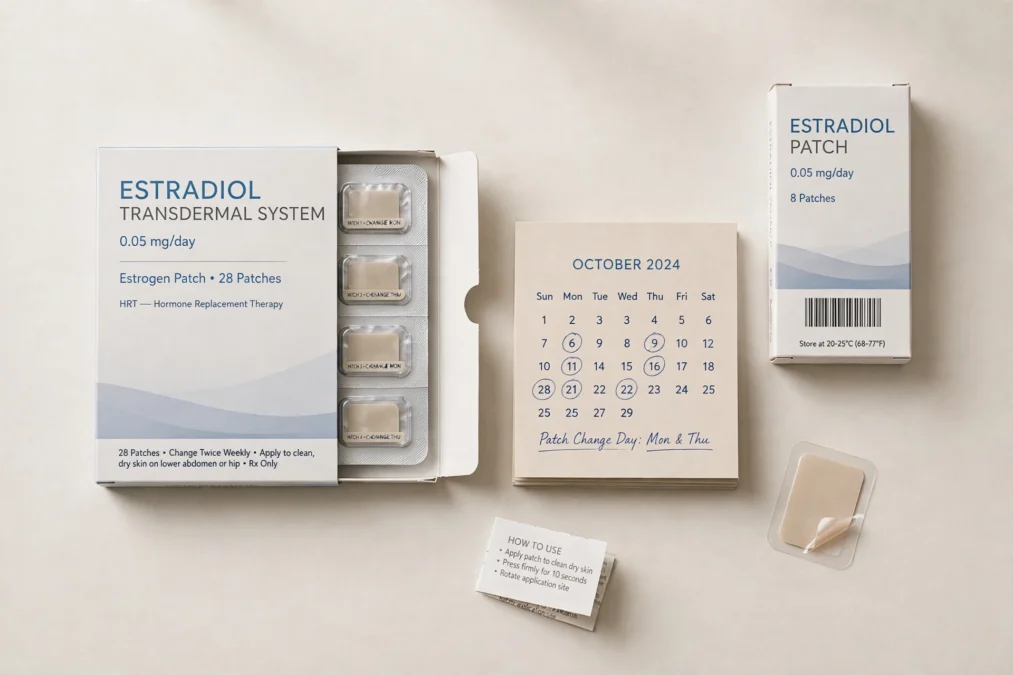
Evorel Sequi patches are a prescription-only sequential combined hormone replacement therapy (HRT) used in the UK to relieve menopausal symptoms in women who still have a womb. Each 28-day treatment cycle works in two halves: for days 1 to 14 you wear an oestrogen-only patch, and for days 15 to 28 you switch to a combined patch containing oestrogen plus the progestogen norethisterone, which protects the womb lining. The patches are changed twice weekly and stuck to the trunk below the waist, and most users experience a monthly withdrawal bleed. As of October 2026, the licensed UK patient leaflet and NHS guidance remain the authoritative references for safe use.
What Are Evorel Sequi Patches?
Evorel Sequi patches belong to the family of transdermal HRT, which means the hormones are absorbed through the skin rather than swallowed as tablets. The active ingredients are estradiol, a form of the body’s own oestrogen, and norethisterone acetate, a synthetic progestogen. Because the oestrogen enters the bloodstream directly through the skin, it bypasses the liver’s first-pass metabolism — and this is precisely why transdermal HRT is often preferred for women with clotting risks, migraines, or higher body weight, where oral oestrogen may be less suitable. Each pack contains eight patches in total: four Evorel 50 patches and four Evorel Conti patches, which together make up one complete 28-day treatment cycle.
The treatment is licensed in the UK both for the relief of menopausal symptoms — such as hot flushes, night sweats, and vaginal dryness — and for the prevention of osteoporosis in postmenopausal women who are at high risk of fractures. It is a prescription-only medicine, and NHS formularies in several regions list it as a first-line transdermal option when specific risk factors are present. The Summary of Product Characteristics advises using the lowest effective dose for the shortest duration, and women are expected to see their doctor about three months after starting or changing treatment, with reviews at least yearly thereafter. If you are unsure whether HRT is right for you, speaking to your GP is the essential first step.
How Does the 28-Day Evorel Sequi Cycle Work?
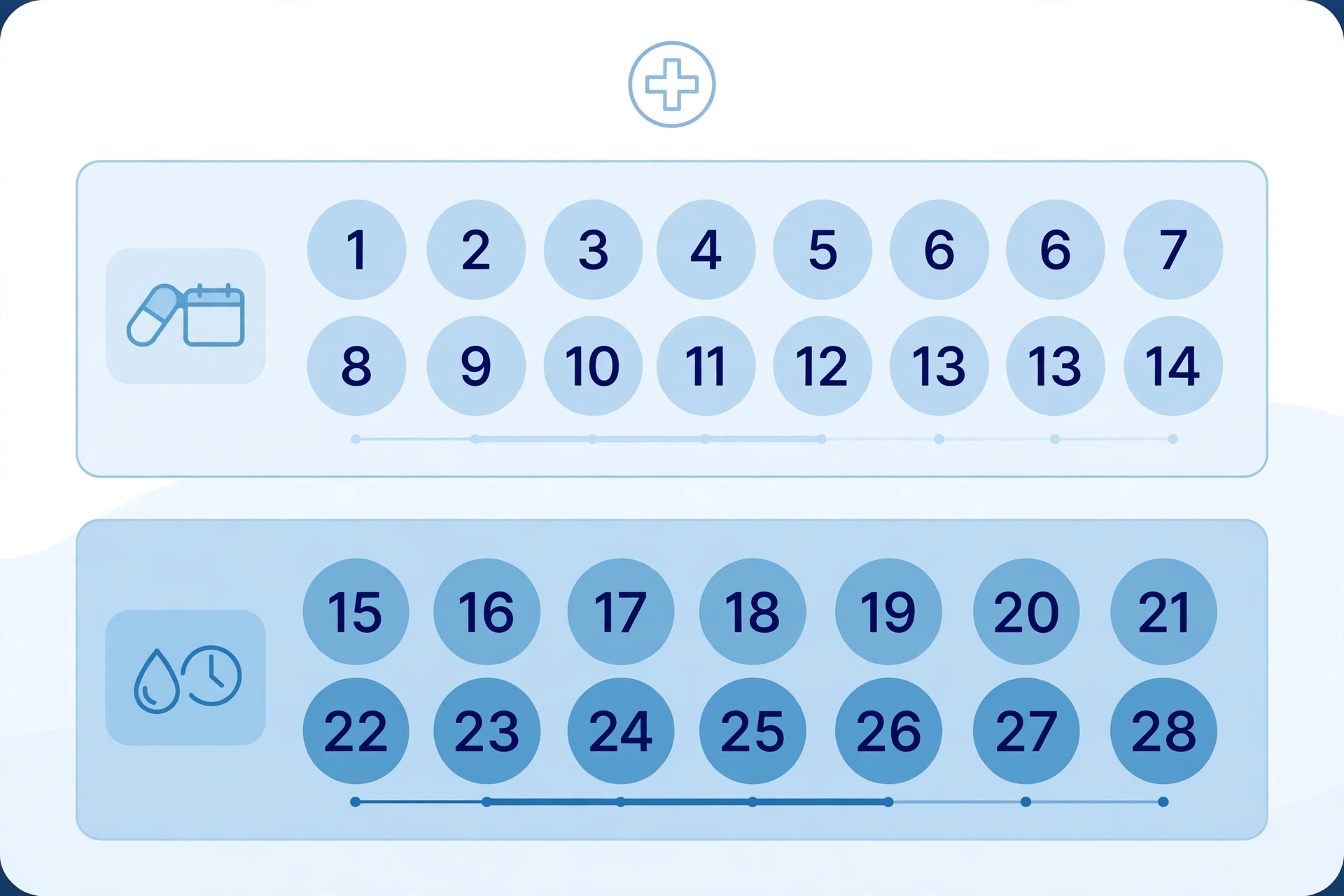
The 28-day cycle is the heart of Evorel Sequi treatment, and understanding it removes most of the confusion new users feel. During days 1 to 14, you wear the Evorel 50 patch, which releases 50 micrograms of estradiol per day — oestrogen alone. Then, for days 15 to 28, you switch to the Evorel Conti patch, which releases the same daily dose of estradiol plus 170 micrograms of norethisterone acetate per day. The addition of the progestogen in the second half is not optional decoration: unopposed oestrogen causes the womb lining to thicken, and the progestogen keeps that lining thin and healthy, which is why sequential HRT is the standard choice for women who have not had a hysterectomy.
A monthly withdrawal bleed — essentially a light, predictable period — is expected and normal on this treatment, typically arriving during week four of the cycle as the hormone levels shift. For many women, especially those in perimenopause who are still having irregular natural periods, this bleed is reassuring rather than alarming. The next 28-day cycle begins immediately after the last patch of the previous cycle is removed; there is deliberately no treatment-free interval, so hormone levels stay consistent from one cycle to the next. If a bleed is unexpectedly heavy, arrives at the wrong time, or continues beyond the first few months, the patient leaflet advises discussing it with a doctor rather than adjusting the patches yourself.
How Should You Apply the Patches?
Patches are changed twice a week — every three to four days — and the golden rule of placement is the trunk, below the waist. Suitable spots include the thigh or the buttock; the patch should never be applied on or near the breasts, and it should go on clean, dry, intact skin that is free from creams, oils, or talcum powder. Press the patch firmly in place with the palm of your hand for at least thirty seconds to make sure the edges stick properly, and try to use a slightly different spot each time so the same area of skin is not irritated by repeated application. A good routine is to pick two fixed change days — for example, Monday and Thursday — and stick to them without fail.
If a patch falls off or you forget to change it on time, the licensed guidance is straightforward: apply a new patch as soon as you notice and continue with your normal schedule, without trying to “catch up” by wearing extra patches. After removing a used patch, fold it in half with the sticky sides together and dispose of it carefully, out of the reach of children and pets, because used patches still contain residual hormone. The patient information leaflet also notes that very hot baths, saunas, or prolonged sunbathing on the patch area are best avoided, since heat can affect how the hormone is absorbed through the skin.
What Dosage Do the Patches Contain?
Each 28-day pack contains four Evorel 50 patches and four Evorel Conti patches. The Evorel 50 patch delivers 50 micrograms of estradiol per 24 hours, while the Evorel Conti patch delivers the same 50 micrograms of estradiol plus 170 micrograms of norethisterone acetate per 24 hours. This is considered a standard rather than a low starting dose, which is why doctors typically begin treatment here and adjust only if symptoms are not controlled or side effects appear. The NHS formulary price for a pack of eight patches is £13.20, though most patients in England pay the standard prescription charge or are exempt from charges entirely. Full dosing details appear in the licensed patient information leaflet.
It is important to understand that the dose is fixed by the product design — you cannot split or trim a patch to take a smaller amount, because cutting a matrix patch disrupts the controlled release of hormone. If the standard dose feels too strong or too weak, that is a conversation for your prescriber, who may switch you to a different product or strength rather than improvising with the patches. The licensed guidance is explicit that treatment should continue only for as long as the benefits outweigh the risks, which is why the annual review matters: HRT is a long-term partnership with your doctor, not a set-and-forget prescription.
Who Can Use These Patches?
Evorel Sequi is intended for perimenopausal and postmenopausal women who still have a uterus and are experiencing symptoms that interfere with daily life — hot flushes and night sweats that wreck sleep, vaginal dryness, mood changes, or the bone-density concerns that come with falling oestrogen. The sequential design makes it particularly suitable for women in perimenopause, whose own cycles are winding down but have not stopped entirely, because the built-in withdrawal bleed feels familiar rather than strange. It is also licensed for osteoporosis prevention in postmenopausal women at high risk of fractures, where other options are unsuitable.
Because the hormones are delivered through the skin, this treatment is often the formulation doctors reach for when tablets are a poor fit. NHS guidance notes that transdermal HRT may be preferable for women with a history of blood clots, since the evidence suggests patches and gels carry a lower clotting risk than oral oestrogen, and the same applies to women with migraines, gallbladder disease, or certain cardiovascular risk factors. That said, suitability is always individual: your medical history, family history, blood pressure, and personal preferences all feed into the decision, and only a prescriber who knows your full picture can make the call.
Who Should NOT Use Them?
The licensed patient information leaflet lists clear situations in which Evorel Sequi must not be used, and these are non-negotiable. They include current, past, or suspected breast cancer; oestrogen-sensitive cancers such as cancer of the womb lining; unexplained vaginal bleeding; untreated thickening of the womb lining (endometrial hyperplasia); current or past blood clots in the veins or lungs; inherited clotting disorders such as protein C, protein S, or antithrombin deficiency; arterial disease including heart attack, stroke, or angina; liver disease; the rare metabolic condition porphyria; and allergy to any ingredient in the patches. The product is not for children, and there is limited experience of its use in women over 65.
Beyond the absolute no-go list, there are conditions that call for extra caution and closer monitoring — including high blood pressure that is not well controlled, diabetes, gallstones, asthma, epilepsy, and a strong family history of breast cancer. This is why the pre-treatment conversation with a doctor matters so much: many of these conditions are manageable alongside HRT, but only with the right supervision. If any of the contraindications develop while you are already using the patches — a new blood clot, unexplained bleeding, or signs of liver trouble — the leaflet advises stopping treatment and seeking medical advice promptly rather than waiting for the next review.
What Side Effects Should You Expect?
The most commonly reported side effects of HRT in general — and Evorel Sequi is no exception — include breast tenderness, headaches, and nausea, which are usually mild and tend to settle within the first three months as the body adjusts to the hormones. The monthly withdrawal bleed is an expected part of the treatment, not a side effect in the usual sense, though its timing and flow can take a couple of cycles to settle into a pattern. Skin irritation where the patch sits is the complaint most specific to the patch format; rotating application sites and making sure the skin is clean and dry before sticking the patch on usually keeps this minor.
More serious side effects are uncommon but must be taken seriously, which is why knowing the warning signs matters. Sudden chest pain, breathlessness, leg swelling or pain, severe headache, vision changes, or jaundice (yellowing of the skin or eyes) all warrant urgent medical attention, as they can signal clots, stroke, or liver problems. Any suspected side effect — common or rare — can be reported in the UK through the MHRA Yellow Card scheme at mhra.gov.uk/yellowcard, and the patient leaflet actively encourages this. As a rule of thumb, if something feels wrong in the first weeks of treatment, mention it at the three-month review or sooner; most early side effects are transient, but you should never have to simply endure them.
How Does Evorel Sequi Differ From Evorel Conti?
This is one of the most common points of confusion, because the names are so similar and Evorel Conti patches are actually used inside the Evorel Sequi pack. The difference is simple: Evorel Sequi is a sequential combined HRT, alternating two weeks of oestrogen-only patches with two weeks of combined patches, and it produces a monthly withdrawal bleed. Evorel Conti, used on its own, is a continuous combined HRT — the same combined patch worn all month, every month — designed for postmenopausal women who prefer no bleeding at all. In short, Sequi mimics a cycle, while Conti aims for a bleed-free steady state.
The choice between the two usually comes down to where a woman is in the menopause transition. Sequential treatment like Evorel Sequi suits perimenopausal women and those within the first year or so after their last natural period, for whom a monthly bleed feels normal. Continuous combined treatment like Evorel Conti is generally reserved for women who are at least a year past their final period, because starting it too early can cause unpredictable spotting. If bleeding becomes troublesome on a sequential regimen, or if a woman on Sequi is several years past menopause, a doctor may suggest switching — but the products are not interchangeable without medical advice.
Conclusion
Evorel Sequi patches offer a well-established, cycle-mimicking route through hormone replacement therapy for women in the UK who still have a womb. The 28-day rhythm — oestrogen alone for two weeks, then oestrogen plus progestogen for two weeks — is straightforward once explained, and the twice-weekly patch change fits easily into a routine. With the transdermal route offering advantages for women with clotting risks or migraines, and NHS formularies listing it as a first-line option in those situations, it remains one of the most commonly prescribed sequential HRTs in Britain as of October 2026.
The keys to getting the best from treatment are consistency and communication: change patches on schedule, place them correctly below the waist, expect the monthly withdrawal bleed, and keep the three-month and annual reviews with your doctor. Read the patient information leaflet that comes with every pack, report anything unusual through the MHRA Yellow Card scheme, and never adjust the regimen on your own. Menopause care works best as a partnership — and with the right guidance, Evorel Sequi can be a reliable part of it. If you have questions about whether HRT suits you, speak to your GP or pharmacist before starting.
Is Evorel Sequi Available on the NHS?
Yes. Evorel Sequi patches are available on NHS prescription in the UK as of October 2026, and several NHS formularies list them as a first-line transdermal HRT option where the patch route is indicated — for example, in women with a BMI over 30, migraine, gallbladder disease, or venous thromboembolism risk factors. The NHS formulary price is £13.20 for a pack of eight patches (one 28-day cycle); patients in England usually pay the standard prescription charge unless exempt. Because it is a prescription-only medicine, you will need a GP or menopause clinic appointment first, and your prescriber will confirm that the benefits outweigh the risks for you personally.
How Long Does It Take for Evorel Sequi Patches to Work?
Most women notice improvement in hot flushes and night sweats within a few weeks of starting treatment, with the full effect typically building over two to three months, according to NHS-aligned HRT guidance. Vaginal dryness and mood symptoms can take a little longer to respond. The licensed guidance recommends a medical review around three months after starting or changing treatment — partly to check that symptoms are improving and partly to confirm that side effects such as breast tenderness or headaches, which are common early on, are settling. If symptoms have not improved meaningfully by the three-month mark, your doctor may adjust the dose or consider a different formulation.
Can You Cut Evorel Sequi Patches in Half?
No — you should never cut, trim, or split Evorel Sequi patches. The patches use a matrix design that releases hormone at a controlled rate across the whole surface, and cutting one disrupts that controlled release, so you cannot reliably get a smaller dose this way. If the standard dose feels too strong or too weak, the correct step is to talk to your prescriber, who may move you to a different product or strength. The licensed patient information leaflet is clear that treatment should use the lowest effective dose, but any change must be made by switching products under medical supervision, not by modifying the patches yourself.
What Should I Do If I Miss an Evorel Sequi Patch Change?
If you forget to change an Evorel Sequi patch on your usual day, apply a new patch as soon as you remember and then continue with your normal twice-weekly schedule — there is no need to wear extra patches to “catch up.” If a patch falls off, stick a new one on a different area of skin below the waist and keep to your regular change days. The patient information leaflet advises against doubling up or extending wear time to compensate, because the hormone delivery is calibrated for the standard 3–4 day wear period. If you are unsure whether you have missed a dose that matters, your pharmacist can advise.
Does Evorel Sequi Cause Weight Gain?
Weight gain is not listed among the established common side effects of this treatment in the licensed patient information leaflet, and clinical evidence does not show that HRT itself causes significant weight gain — though many women notice weight changes around menopause regardless of treatment, driven by hormonal shifts, ageing, sleep disruption, and reduced activity. Some users report mild fluid retention or bloating in the early weeks, which usually settles. If you experience sustained or worrying weight change after starting the patches, raise it at your GP review so other causes can be checked rather than assuming the HRT is responsible.