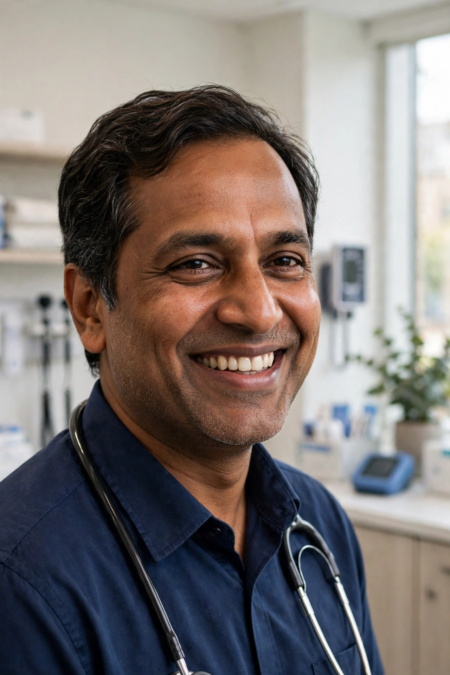
Dr Amir Khan is a full-time NHS GP in Bradford who has become one of Britain’s most trusted television doctors, appearing regularly as the resident doctor on ITV’s Good Morning Britain and Lorraine. Now in his mid-40s, he is also a Sunday Times bestselling author, a senior university lecturer, and the President of the RSPB, the UK’s largest nature conservation charity. What sets him apart from most media medics is that he never left frontline practice: he still sees patients in inner-city Bradford every week, bringing real consulting-room experience to every television segment he films.
This biography brings together everything verified about his life and career in one place — his Bradford upbringing and medical training, his rise through daytime television, his books and writing, his awards and conservation work, and an honest account of what is (and is not) publicly known about his personal life. Every fact below comes from reputable interviews and official sources; where information has not been made public, we say so plainly rather than filling the gaps with speculation, because accuracy matters far more than completeness.
Who Is Dr Amir Khan? (Direct answer)
Dr Amir Khan is a British-Pakistani general practitioner who works full-time for the NHS in Bradford, West Yorkshire, while also serving as ITV’s resident TV doctor on Good Morning Britain and Lorraine. Viewers know him for his warm, plain-speaking explanations of everything from winter bugs to complex conditions, delivered without jargon and often with humour. Beyond broadcasting, he is a bestselling author of three books, a Senior Lecturer at two universities, and an increasingly prominent voice in nature conservation and public health campaigning.
His unusual appeal lies in the combination of credibility and approachability: here is a doctor who spent the morning seeing real patients with real problems, then appears on lunchtime television translating the day’s health headlines into advice ordinary people can actually use. That dual life — stethoscope in the morning, studio lights in the afternoon — has earned him hundreds of thousands of devoted followers and a reputation as one of the most trusted communicators in British healthcare media, a status built steadily over years of consistent and honest broadcasting.
Early Life and Medical Training
Amir Khan was born and raised in Bradford, West Yorkshire, the son of a bus driver and a social worker, and he has spoken often and proudly about his British Pakistani heritage and his parents’ emphasis on education and hard work. Growing up in one of England’s most diverse cities shaped his understanding of the health challenges facing underprivileged communities, and that early perspective still informs both his clinical work and his campaigning. He has also spoken candidly about encountering racism throughout his life, including patients refusing to see him because he is an Asian doctor.
He studied medicine at the University of Liverpool, graduating with an honours degree in 2004, then completed junior doctor posts across Merseyside before qualifying as a GP in 2009. Along the way he collected diplomas in Child Health, in Obstetrics and Gynaecology, and in diabetes care, developing special interests in Type 2 diabetes, minor surgery and joint injections. Rather than chasing a hospital consultancy, he returned to Yorkshire to serve the kind of community he grew up in — a decision that defines his career to this day.
Television Career

Dr Amir Khan’s television career began with his role as resident doctor on ITV’s Lorraine, where his clear, compassionate explanations of health stories quickly made him a viewer favourite. That success led to the same role on Good Morning Britain, and he has since become a fixture of ITV daytime, alongside contributions to Tonight, BBC Breakfast, This Morning and Sky News. His presenting style — translating complex medical topics into plain, accessible advice without ever talking down to the audience — is consistently cited as the reason producers and viewers alike keep inviting him back.
Beyond the sofa segments, he has fronted his own programmes, including the Channel 5 documentary series GPs: Behind Closed Doors, which offered an unusually honest look at the pressures facing modern general practice. More recently he has explored new formats, including a women’s health podcast launched with presenter Cherry Healey tackling subjects like medical misogyny. He shares the ITV daytime family with presenters such as Ben Shephard, and like all long-serving morning television faces, he has learned to handle both devoted fans and the harsher side of social media attention.
Books and Writing
His first book, The Doctor Will See You Now (2020), drew on fifteen years as an NHS GP to paint a vivid, humane picture of life on the medical front line, and it became a Sunday Times bestseller. Written with warmth and candour, the memoir introduced readers to the patients, colleagues and impossible pressures behind the surgery door, establishing him as a writer with genuine literary ability rather than merely a television personality with a ghostwriter. Its success confirmed that the public appetite for honest NHS storytelling extended well beyond the television screen.
He followed it with How (Not) to Have an Arranged Marriage (2023) and then with How Families Are Made, an inclusive children’s book for six-to-nine-year-olds exploring different kinds of families — from step-parents and adoptive parents to same-sex couples and surrogacy — alongside a gentle introduction to how babies are made. Alongside books, he has contributed to an eclectic range of magazines including Gardener’s World, BBC Wildlife Magazine, Grazia and Good Housekeeping, reflecting the unusual breadth of his interests beyond medicine. Each project circles the same themes: clarity, inclusivity and demystifying subjects people find difficult to discuss.
Awards, Teaching and Nature Advocacy
In 2018 the Royal College of General Practitioners named him GP Trainer of the Year, recognising his work mentoring the next generation of family doctors, and he serves as a Senior Lecturer at both the University of Leeds School of Medicine and the University of Bradford. These academic roles matter because they anchor his media work in genuine educational practice: he is not simply performing expertise on television but actively training the doctors of tomorrow. That combination of teaching, training and frontline practice gives his public health commentary a weight that pure broadcasters cannot easily match.
In October 2022 he was elected President of the RSPB for a three-year term, a striking appointment that recognised his passionate advocacy for nature’s role in human health. He is also Vice President of The Wildlife Trusts and an ambassador for Butterfly Conservation, the Good Grief Trust and the British Hedgehog Preservation Society, and he regularly shares the wildlife of his own Yorkshire garden — bullfinches, hedgehogs and all — with hundreds of thousands of social media followers. As the RSPB’s official profile notes, he speaks with medical authority on why access to green space benefits us, a message that resonated powerfully during and after the pandemic lockdowns.
Personal Life
Dr Amir Khan keeps his private life firmly private, and — refreshingly for a public figure — the media has largely respected that boundary. He is known to live in a village just outside Leeds, where he has transformed a once-neglected sloping garden into a celebrated wildlife haven through years of trial, error and enthusiastic learning. His known interests beyond medicine include gardening, running, fitness, baking and travel, and the RSPB describes him as a devoted uncle and godfather who wants the wildlife he treasures to survive for future generations.
What he has not shared publicly, we do not report: details about a partner or children have never been confirmed by him in any reputable interview, and gossip sites’ claims on the subject are unverified. That discretion extends to how he handles fame itself — he has spoken openly about being trolled online and about the racism he has faced, but he discusses these experiences to highlight wider issues rather than to invite sympathy. In an era of relentless celebrity oversharing, his quiet insistence on a private life is arguably part of his appeal.
Conclusion
Dr Amir Khan’s story is, at heart, about refusing to choose between callings: he is simultaneously a working Bradford GP, a national television doctor, a bestselling author, a university lecturer and a conservation leader, and he brings the credibility of each role to all the others. From a Bradford childhood as the son of a bus driver and a social worker to the presidency of the RSPB, his trajectory reflects both exceptional drive and a deep sense of service to the communities that shaped him.
Whether explaining a health scare on Good Morning Britain, training young GPs, or filming the bullfinches in his Yorkshire garden, he returns obsessively to the same message: that good health, clear information and access to nature should belong to everyone, not just the privileged. That is why the public trusts him — and why his influence is likely to keep growing well beyond the consulting room and the television studio, inspiring patients, viewers and nature lovers alike to take charge of their own wellbeing.
How Old Is Dr Amir Khan?
Dr Amir Khan is in his mid-40s. He has never publicised an exact birth date, and reputable profiles describe him as 42 to 44 in recent interviews, which is consistent with graduating in medicine in 2004 and qualifying as a GP in 2009. Some low-quality gossip sites publish specific birthdays and ages, but these are unverified and frequently contradict one another, so they should not be trusted. What is certain is that he qualified as a doctor around two decades ago and has spent the years since building parallel careers in frontline general practice, broadcasting, writing and conservation.
Is He Still a Practising GP?
Yes — and this is central to his public identity. Despite his television commitments, bestselling books and charity presidencies, he continues to work as a full-time NHS GP in inner-city Bradford, the city where he was born and raised. He has said repeatedly that frontline practice keeps his broadcasting honest, because the questions he answers on television are the same ones his patients ask him in the consulting room. In an era when many media doctors step back from clinical work, his insistence on staying on the NHS front line is a large part of why viewers and colleagues trust his advice.
What TV Shows Does He Appear On?
He is best known as the resident doctor on ITV’s Lorraine and Good Morning Britain, the two flagship daytime shows where he explains health stories and answers viewer questions. Beyond those regular slots, he fronted the Channel 5 documentary series GPs: Behind Closed Doors and has contributed to Tonight, BBC Breakfast, This Morning and Sky News. He has also branched into other formats, including health-focused documentaries and a women’s health podcast with Cherry Healey. His television work is unified by a single approach: taking complex or frightening medical topics and rendering them in plain, reassuring language.
Has He Written Any Books?
He has written three books. The Doctor Will See You Now (2020) is his Sunday Times bestselling memoir of fifteen years as an NHS GP, praised for its warmth and honesty about life on the medical front line. How (Not) to Have an Arranged Marriage (2023) followed, and then How Families Are Made, an inclusive children’s book introducing six-to-nine-year-olds to different kinds of families. Alongside his books he writes for magazines as varied as Gardener’s World, BBC Wildlife Magazine, Grazia and Good Housekeeping. His writing consistently aims to demystify difficult subjects — whether illness, family or identity — with clarity and compassion.
Where Is Dr Amir Khan From?
He is from Bradford, West Yorkshire, where he was born and raised as the son of a bus driver and a social worker. He is proud of his British Pakistani heritage and has spoken about how growing up in one of England’s most diverse cities shaped his understanding of healthcare inequality. After studying medicine at the University of Liverpool and training across Merseyside, he deliberately returned to Yorkshire to practise, and he still works as a GP in Bradford today. He now lives in a village just outside Leeds, where his celebrated wildlife garden has become almost as famous as he is.
What Is Dr Amir Khan’s Role With the RSPB?
In October 2022 he was elected President of the RSPB — the Royal Society for the Protection of Birds, the UK’s largest nature conservation charity — for a three-year term. The role recognises his passionate advocacy for the links between nature and human health, a subject he speaks about with unique authority as both a doctor and a keen wildlife gardener. He supports RSPB campaigns including the Big Garden Birdwatch, champions birds of prey, and uses his large social media following to encourage people of all backgrounds to connect with nature. He also serves as Vice President of The Wildlife Trusts and as an ambassador for several other wildlife and bereavement charities.