If you or someone you love has just been told they need a stoma, it’s completely normal to feel overwhelmed. This guide explains everything in plain language: what a stoma is, the different types, why they’re needed, what the operation involves, and what life is really like afterwards.
Take a breath. A stoma is a life-saving, life-restoring procedure performed every day across the UK, and with modern stoma care, most people return to full, active lives.
What Exactly Is a Stoma?
A stoma is a small, surgically created opening on the surface of your tummy (abdomen). It connects an organ inside your body to the outside, giving waste a new route out of your body when the normal route can no longer be used.
The word “stoma” comes from Greek, meaning “mouth” or “opening” — a good mental image. The stoma sits on your abdomen, usually below your belly button, and waste — poo or urine — passes out through it into a discreet pouch or bag that sticks to your skin.
Here’s what helps most people understand it: a stoma isn’t a wound, and it isn’t painful. It looks pink and moist, a bit like the inside of your mouth, and it has no nerve endings, so you can’t feel it being touched. It can bleed slightly if rubbed, but that’s normal.
The operation that creates a stoma is called an ostomy. That’s why you’ll sometimes hear the terms used together — the stoma is the opening itself, and the ostomy is the operation.
The Three Main Types of Stoma
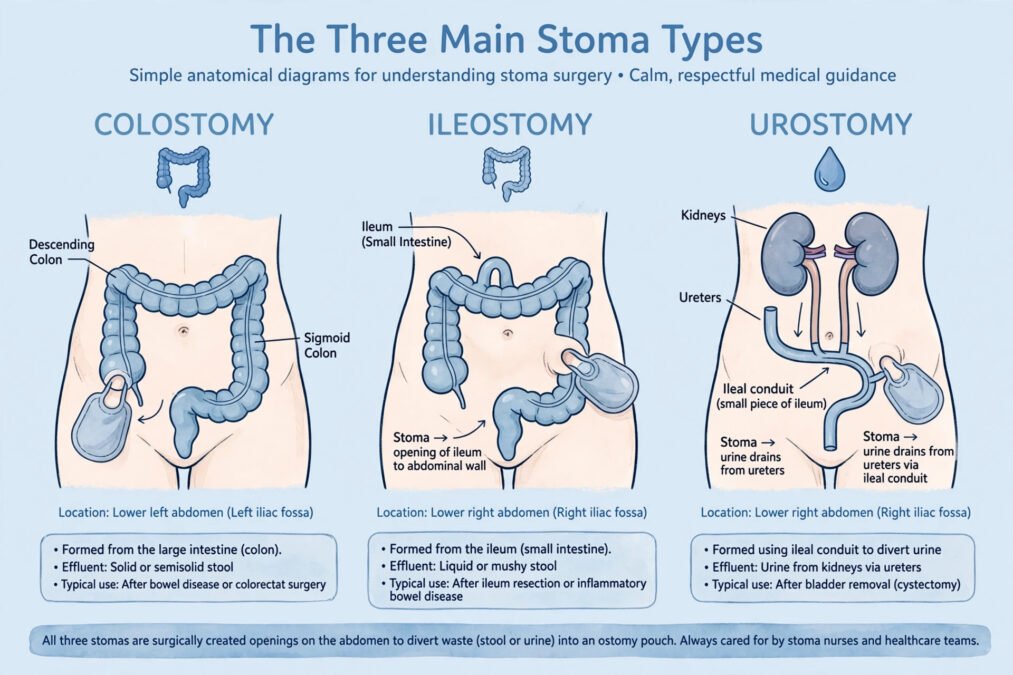
There are three main types of stoma, and they differ in which part of the body they connect to and what comes out of them.
Colostomy
A colostomy connects your large bowel (colon) to a stoma on your tummy. Poo leaves the body through this opening instead of through your bottom, and is collected in a pouch worn on your abdomen.
- Where it sits: usually on the left side of the tummy
- What comes out: stool, which may be soft or fairly formed, depending on which part of the colon is used
- Output pattern: colostomies tend to be less active than ileostomies — many people empty or change their pouch once or twice a day
The NHS guide to what a colostomy is gives a clear, plain-English overview.
There are two main varieties. A loop colostomy brings a loop of colon through the skin (usually temporary, to rest the bowel while it heals). An end colostomy brings the end of the colon through the skin; often permanent, for example after surgery for bowel or rectal cancer.
Ileostomy
An ileostomy connects the end of your small bowel (the ileum) to a stoma on your tummy. Because the small bowel is upstream of the large bowel — where most water is absorbed — the output is looser than with a colostomy.
- Where it sits: usually on the right side of the tummy
- What comes out: loose or porridge-like stool, which flows continuously throughout the day
- Output pattern: the pouch needs emptying several times a day
The NHS guide to ileostomy explains that an ileostomy brings the end of the small bowel through an opening in the tummy to form a stoma, and it may be temporary or permanent depending on why it’s needed. Because ileostomies lose more fluid, staying well hydrated is especially important — your stoma nurse will talk you through this.
Urostomy
A urostomy (also called an ileal conduit) is for urine rather than poo. It’s usually created after bladder removal, most commonly for bladder cancer. The surgeon takes a short piece of the small bowel and uses it as a tube (a “conduit”) to carry urine from the kidneys out through a stoma.
- Where it sits: usually on the right side of the tummy
- What comes out: urine, draining continuously
- Output pattern: the pouch has a tap at the bottom so you can drain it into the toilet — usually emptied every couple of hours
Why Would Someone Need a Stoma?
A stoma is never the first choice — it’s offered when it’s the safest option. The main reasons include:
- Bowel cancer: one of the most common reasons. A stoma may be needed after removing part of the bowel, or temporarily to let the bowel heal after surgery. In some cases, it bypasses a blockage caused by a tumour.
- Inflammatory bowel disease (IBD): Crohn’s disease and ulcerative colitis can damage the bowel so severely that part of it needs to be removed, or the bowel needs complete rest. For ulcerative colitis, some people have their entire colon removed and live with an ileostomy.
- Bladder conditions: bladder cancer requiring bladder removal is the main reason for a urostomy. Certain congenital or nerve-related bladder problems can also lead to one.
- Diverticulitis and infections: severe infection or an abscess in the bowel may require emergency surgery with a temporary stoma.
- Bowel obstruction or blockage: when poo can’t move through the bowel, a stoma can relieve the blockage.
- Injury or trauma: serious abdominal injuries sometimes need a stoma while the bowel heals.
- Other conditions: bowel incontinence that can’t be treated, pelvic tumours, fistulae (abnormal connections between organs), and some neurological conditions affecting bowel control.
Temporary or Permanent?
This is one of the first questions people ask, and the honest answer is: it depends on the reason.
- Temporary stomas are usually formed to give the bowel time to rest and heal after surgery or illness — typically for a few months. Once healed, the bowel can be joined back together in an operation called a reversal.
- Permanent stomas are needed when the bowel or bladder can’t be safely reconnected — for example, after the rectum or bladder has been removed.
Your surgeon will explain which type applies to you before the operation, and your stoma nurse will talk through what it means for recovery.
What Happens During Stoma Surgery?
Knowing what to expect can take a lot of the fear out of the operation. Here’s the typical journey:
- Pre-operative appointment: you’ll meet your surgeon and — crucially — your stoma care nurse. Before surgery, they will usually mark the best position for the stoma on your tummy, taking into account your body shape, clothes, and daily activities.
- The operation itself: stoma surgery is done under general anaesthetic, so you’ll be asleep and won’t feel anything. It can be done as keyhole (laparoscopic) surgery through small cuts, or as open surgery with a larger cut.
- Hospital stay: most people stay in hospital for about 4–7 days, sometimes longer after bigger operations. You’ll be up and moving within a day or two — early movement helps recovery.
- Learning stoma care: before you go home, your stoma nurse will teach you how to empty and change your pouch, how to care for the skin around the stoma, and what supplies you’ll need. Follow-up appointments and support continue after discharge.
Life with a Stoma: The Day-to-Day Reality
This is the section most people are really searching for — and the reassuring truth is that life with a stoma can be remarkably ordinary. Here’s what daily life actually involves.
Caring for Your Pouch
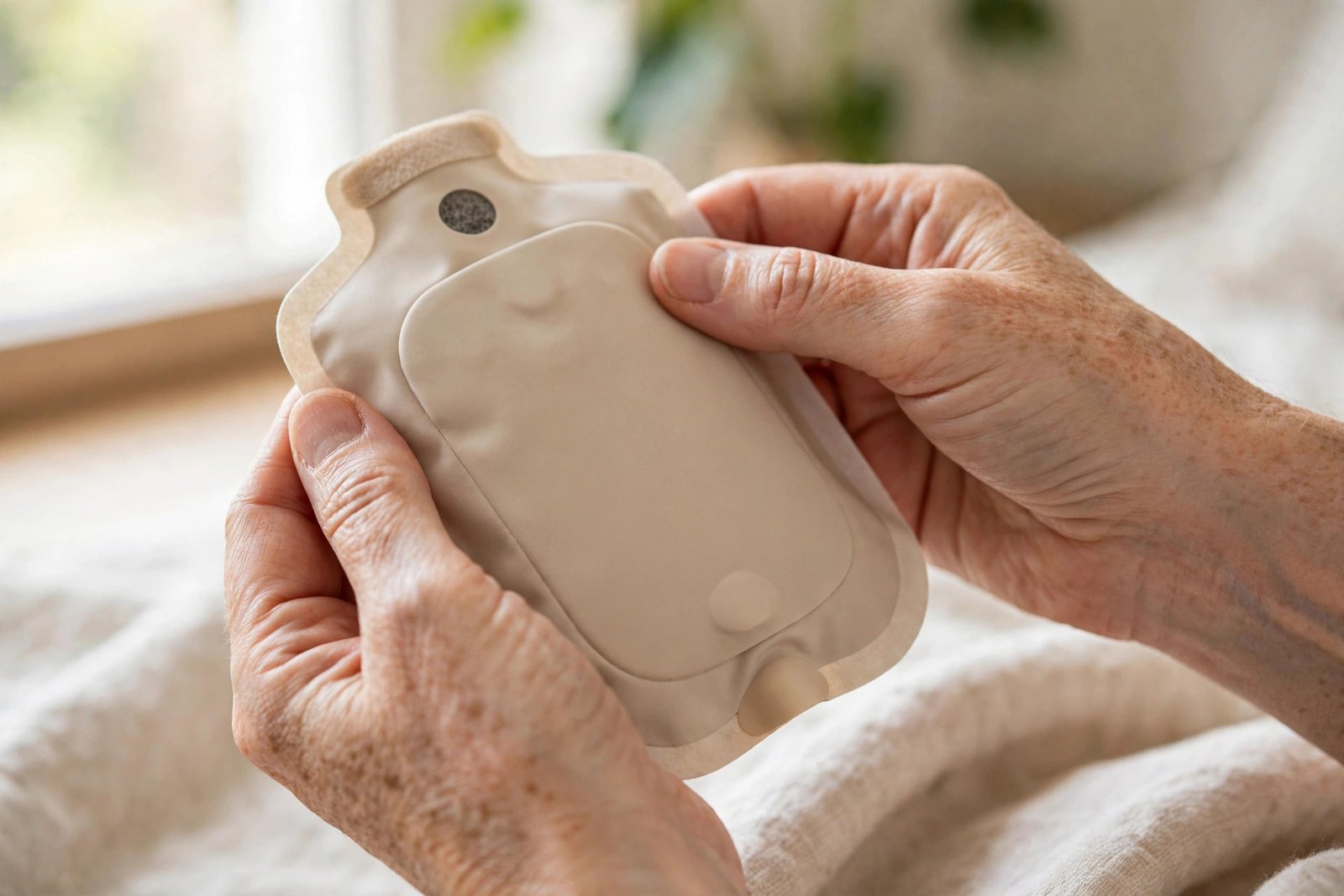
Modern stoma pouches are discreet, odour-proof, and designed to be comfortable. You’ll quickly develop a routine:
- Changing the pouch: how often depends on the type. Colostomy pouches are often changed once or twice a day; ileostomy pouches need emptying several times a day and changing every few days.
- Skin care: keeping the skin around the stoma clean and dry is the most important part of stoma care. Warm water and soft wipes are enough — avoid perfumed soaps or oily creams unless your stoma nurse recommends them.
- Supplies on the NHS: stoma supplies are free on prescription in the UK. Your stoma nurse arranges your first supplies before you leave hospital, and you’ll reorder through your GP surgery afterwards.
Most people find that within a few weeks, pouch care becomes routine.
Eating and Diet
In the first 6–8 weeks after surgery, you’ll be advised to take it gently — low-fibre foods, chewing well, and avoiding things like raw vegetables, nuts, seeds, and very spicy food while everything heals.
Longer term, most people return to a normal diet. A few practical tips:
- Reintroduce foods gradually, one at a time, so you learn what suits you
- Chew food thoroughly, especially with an ileostomy, to help prevent blockages
- Stay well hydrated — particularly important with an ileostomy, as you lose more fluid
- Some foods (like cabbage, pulses, fizzy drinks, and onions) can cause more wind; you don’t have to avoid them entirely, just learn your own pattern
Your stoma nurse or an NHS dietitian can give you personalised advice based on your stoma type.
Exercise, Work, and Daily Activities

- Exercise: walking is encouraged as soon as you feel up to it. Most people can return to other exercise — including swimming and team sports — once their surgeon gives the go-ahead, usually within 6–8 weeks. Pouches are waterproof, so swimming is absolutely fine. Take it gradually with anything involving heavy core strain to reduce the risk of a hernia around the stoma.
- Work: most people return to work after recovery. Under the Equality Act 2010, a stoma counts as a disability if it has a substantial, long-term effect on daily life, so your employer must make reasonable adjustments — like access to a private toilet or flexible breaks.
- Travel: travelling with a stoma is entirely possible. Pack extra supplies in your hand luggage, carry a note explaining your medical needs for security checks, and check travel insurance covers your condition. Many experienced “ostomates” travel the world.
Relationships and Intimacy
This is a sensitive subject, but an important one. It’s normal to worry about how a stoma affects body image and intimate relationships. Be honest with yourself and your partner — and know that many people report their intimate lives continue much as before once they’ve adjusted.
Practical tips: smaller or closed pouches are available for intimacy, and supportive underwear or wraps can help you feel more confident. Your stoma nurse can discuss this with you — they’ve heard it all before. If body image worries persist, counselling is available through the NHS.
The Emotional Side: Adjustment and Support
- Give yourself time. The first few weeks are the hardest; things usually improve significantly within a few months.
- Your stoma care nurse is your first port of call for both practical problems and emotional ones — they understand the psychological side and can refer you for counselling.
- Talk to people who’ve been there. Charities like Colostomy UK and the Ileostomy and Internal Pouch Association (IA) offer peer support, helplines, and local groups. Hearing from someone living well with a stoma can be transformative.
- Tell people on your terms. You decide who knows about your stoma. Many people find that close friends and family take it in their stride.
Remember: having a stoma often means freedom from the illness that made it necessary — no more pain, urgency, or fear of accidents. Many people say their quality of life improves dramatically.
Common Complications to Watch For
Most stomas settle down without problems, but it’s wise to know what to look out for:
- Skin irritation or soreness around the stoma — usually caused by leaks or a poorly fitting pouch. Your stoma nurse can help adjust your appliance.
- Parastomal hernia — a bulge around the stoma where tissue pushes through the abdominal wall. Support garments can help; surgery is sometimes needed.
- Stoma retraction or prolapse — the stoma pulling inward or sticking out further than usual. Different pouch types and accessories can usually manage this.
- Dehydration — more likely with an ileostomy. Watch for fatigue, dry mouth, and dark urine.
When to Seek Medical Help
Contact your stoma nurse, GP, or NHS 111 — or find a walk-in clinic near you for urgent care — if you notice:
- Lots of blood coming from your stoma or in your pouch
- Signs of dehydration — fatigue, dry mouth, feeling dizzy
- No output from your stoma for much longer than is normal for you
- Severe tummy pain, cramps, nausea, or vomiting
- High temperature, or feeling hot, cold, or shivery
- Redness, swelling, or discharge suggesting infection
- A stoma that has changed colour (very pale, dark, or black), which needs urgent attention
Call 999 or go to A&E if you have severe tummy pain with vomiting and no stoma output — this could be a bowel blockage, which is an emergency.
FAQs About Stomas
Does a stoma hurt?
No. A stoma has no nerve endings, so you can’t feel it. It may bleed slightly if scratched or wiped roughly, but this is normal and painless.
Can you live a normal life with a stoma?
Yes. Most people return to work, exercise, travel, swimming, and socialising. Modern stoma pouches are discreet and odour-proof, and with a little practice, caring for a stoma becomes part of your normal routine.
How long can you live with a stoma?
A stoma itself doesn’t shorten your life — your outlook depends on the underlying condition that made it necessary. Many people live with a stoma for decades; there are people who’ve had one for 50 years or more.
Can a stoma be reversed?
Temporary stomas can often be reversed with a second operation that joins the bowel back together. Whether reversal is possible depends on why the stoma was created — your surgeon will discuss this with you.
Will other people know I have a stoma?
No — stoma pouches are flat, discreet, and worn under your clothes. They’re also odour-proof when fitted correctly. Most people are surprised by how unnoticeable a stoma pouch is.
Can I eat normally with a stoma?
After the initial healing period (usually 6–8 weeks), most people return to a normal diet. You may need to take extra care with very high-fibre foods and stay well hydrated, but your stoma nurse or dietitian can advise you personally.
Will having a stoma affect having children?
A stoma doesn’t usually affect fertility. Pregnancy with a stoma is possible, though you’ll need extra monitoring — talk to your stoma nurse and obstetrician if you’re planning a pregnancy.
A Final Word
Hearing that you need a stoma can feel like the end of the life you knew. In reality, for most people, it’s the beginning of a better one — free from the symptoms and fear that made the operation necessary.
Disclaimer: This article is for information only and is not medical advice. If you have concerns about a stoma or your own health, please speak to your GP, your stoma care nurse, or call NHS 111. For emergencies, call 999.