The internet has a profound affection for viral personality quizzes, but few have managed to capture the collective global imagination quite like the pooh pathology test. This fascinating psychological assessment takes users on a deeply nostalgic journey back to the beloved Hundred Acre Wood, but it arrives with a distinctly modern, analytical twist. Instead of merely matching your favorite childhood habits or sweet preferences, it looks extensively into your subconscious behavioral patterns. By answering a series of carefully targeted prompts, the quiz connects your underlying personality quirks with one of A.A. Milne’s classic, timeless literary characters.
While the concept sounds entirely lighthearted on the surface, the assessment actually holds up a remarkably accurate mirror to our daily struggles, secret anxieties, and distinct coping mechanisms. However, it is absolutely essential to establish a healthy, realistic boundary right from the very beginning of our exploration: despite its clever use of clinical terminology, this online assessment is built for self-discovery rather than true medical analysis. It serves as an accessible, comforting gateway to complex psychological concepts, allowing everyday users to explore their internal emotional landscapes through fictional figures they have deeply loved since early childhood.
Understanding the True Meaning and History of the Pooh Pathology Test
The surprising historical origins of the viral pooh pathology test trace back to an unexpectedly academic and prestigious scientific source. In December of 2000, a group of extraordinarily clever pediatricians led by Dr. Sarah Shea published a playful yet highly insightful research paper in the renowned Canadian Medical Association Journal. The academic researchers famously observed that the specific behaviors of Winnie the Pooh and his forest companions perfectly mirrored distinct psychiatric conditions, paving the way for modern digital developers to eventually convert these observations into an interactive, highly shareable internet quiz format.
Today, the contemporary version of the pooh pathology test typically consists of several dozen analytical statements where participants carefully rate their level of personal agreement on a sliding scale. The backend algorithm dynamically calculates your unique cognitive tendencies and compares those metrics directly against the behavioral baselines established for Christopher Robin’s famous stuffed animals. It has grown into a massive global digital phenomenon, prompting millions of social media users to actively share their colorful charts, discuss mental health more openly, and laugh about their shared personality traits with friends.
The Seven Winnie the Pooh Archetypes and Their Deep Psychological Profiles
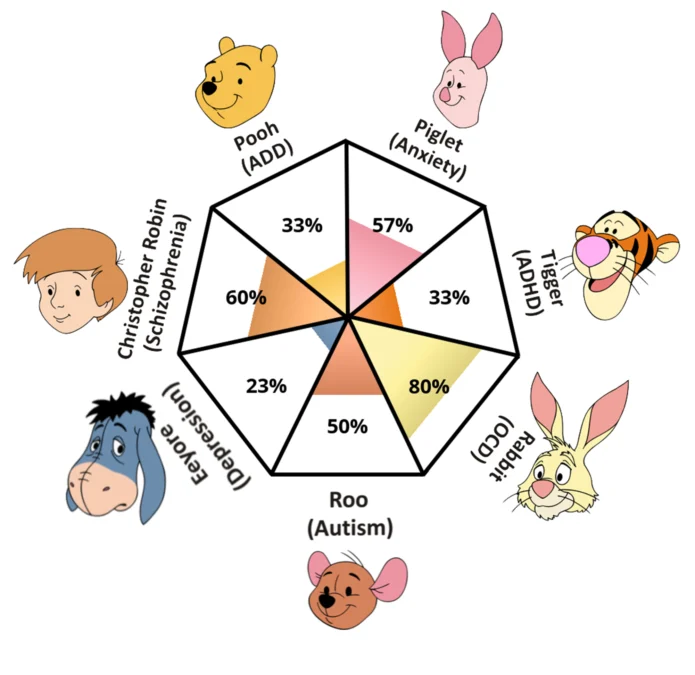
Every single character living in the fictional Hundred Acre Wood represents a highly specific, easily recognizable behavioral archetype within the structural framework of the pooh pathology test. For instance, Winnie the Pooh himself is frequently linked to Attention Deficit Disorder due to his severe lack of focus, random impulsivity, and obsessive fixation on obtaining honey. Meanwhile, fragile little Piglet serves as the textbook definition of Generalized Anxiety Disorder, constantly hiding from perceived environmental dangers, overthinking minor situations, and letting excessive, irrational worry control his everyday life.
Moving across the sunny forest, the hyperactive and bouncy Tigger perfectly embodies the restless physical energy of ADHD, frequently taking reckless risks and jumping into situations without ever considering the long-term consequences. In stark, dramatic contrast, gloomy Eeyore represents chronic low-grade depression, medically known as dysthymia, consistently viewing every single situation through a dark lens of permanent sadness and defeat. Rabbit displays severe Obsessive-Compulsive Disorder traits through his desperate, aggressive need for total control, Owl struggles with overcompensating intellectual narcissism, and Christopher Robin displays a highly active, dissociative imagination that manifests a completely fictional universe.
Comparing the Pooh Pathology Quiz with Real Medical Diagnostics

To fully comprehend this massive viral trend, it helps enormously to understand exactly what a real-world clinical pathology test actually entails in a hospital environment. In the strict medical community, the true pathology meaning refers explicitly to the scientific study of the structural and functional changes caused in the body by physical diseases. When a licensed doctor orders a routine, clinical pathology test, a specialized laboratory carefully analyzes biological fluids, blood samples, or physical tissue biopsies under high-tech microscopes to catch tangible, verifiable illnesses.
Therefore, we must clearly recognize that a strict pathology definition completely separates physical laboratory sciences from these entertaining, online psychological character quizzes. While a clinical medical specialist relies strictly on diagnostic manuals, rigorous scientific testing, and biological markers, the popular pooh pathology test operates purely on subjective, self-reported behavioral answers. It remains incredibly valuable for sparking internal awareness and starting important cultural conversations about mental wellness, but it completely lacks any formal medical authority to provide a legitimate psychiatric diagnosis.
Why Modern Culture is Obsessed with Nostalgic Personality Assessments
Human beings possess an innate, deep-seated desire for self-classification, personal validation, and a comforting sense of digital belonging, which perfectly explains why the pooh pathology test continues to trend globally. True psychological frameworks can often feel incredibly clinical, cold, distant, or intimidating to the average person searching for answers. Framing these complex, heavy emotional struggles through familiar, nostalgic childhood icons makes the intimidating process of deep self-reflection feel entirely safe, approachable, and deeply comforting for users of all generations.
Furthermore, this massive digital phenomenon relies heavily on the Barnum Effect, a fascinating psychological concept where individuals firmly believe that generic personality descriptions apply specifically and perfectly to them. When the quiz eventually reveals that you possess a exceptionally high percentage of Eeyore or Rabbit traits, it provides a strange sense of validation for your internal, silent struggles. It beautifully reminds us that our personal vulnerabilities are completely normal, highly relatable, and intricately woven into the timeless fabric of shared human storytelling.
How to Take the Test and Correctly Interpret Your Personal Results
If you truly want to get the most accurate and insightful results from your pooh pathology test, you must approach every single question with absolute honesty. It is incredibly tempting to select idealized answers that reflect who you want to be in a perfect world, rather than how you truly react under real, messy everyday stress. The intuitive slider system requires you to weigh your daily habits quite carefully, ultimately yielding a highly personalized multi-character chart that illustrates your dominant cognitive traits.
When your final visual breakdown displays a complex mixture of several different forest characters, always remember that human personalities are naturally multidimensional and beautifully layered. Scoring a high percentage in anxiety or hyperactivity simply highlights specific areas where you experience emotional intensity in your current daily routine. Treat these final metrics as an encouraging, friendly starting point for personal growth, or as a helpful prompt to speak with a licensed professional if certain behavioral patterns ever begin to feel overwhelming.
Embracing Our Personal Quirks with Compassion and Mental Awareness
Ultimately, the viral pooh pathology test serves as a brilliant intellectual bridge connecting precious childhood nostalgia with modern psychological awareness. It masterfully strips away the heavy societal stigma that is so often associated with mental health conversations, replacing fear and judgment with familiar, comforting faces from our past. By looking at our personal flaws through the gentle lens of characters like Pooh, Tigger, or Piglet, we learn to view our complex emotional lives with a lot more lighthearted humor and gentle self-compassion.
However, keeping a healthy dose of reality remains absolutely essential when navigating these viral digital trends across the internet. Enjoy the online quiz for the highly engaging, deeply reflective, and genuinely entertaining experience that it was always meant to be for the public. Use your unique character results to foster deeper everyday self-awareness and stronger empathy for the diverse people around you, while leaving official medical evaluations and clinical diagnoses to the properly trained professionals.
Frequently Asked Questions Regarding the Viral Quiz
Can the pooh pathology test be used as a substitute for an official mental health diagnosis? Absolutely not under any circumstances. While the online quiz is loosely inspired by a real, lighthearted observational research paper published by pediatricians back in the year 2000, it is entirely intended for entertainment, amusement, and basic self-reflection. A genuine psychiatric or psychological diagnosis requires an extensive, formal evaluation conducted in person by a licensed healthcare professional or clinical psychologist.
What is the actual medical definition and purpose of a real pathology test? In the legitimate scientific and medical field, a true pathology test involves the rigorous laboratory examination of physical biological samples—such as blood, cells, urine, or tissue biopsies. This precise, highly scientific process allows doctors and laboratory specialists to accurately identify, track, and treat specific physical medical diseases, genetic conditions, and underlying bodily infections.
Why do I frequently score highly on multiple different characters at the exact same time? Human beings are incredibly complex and multidimensional, meaning it is completely normal to exhibit overlapping behavioral traits across the board. You can easily possess the cautious, worrying nature of Piglet during stressful work weeks alongside the occasional unfocused, impulsive sweet tooth of Winnie the Pooh, reflecting a natural, beautifully balanced psychological composition.
You may also read: Is Slapped Cheek Contagious? The Transmission Window