
If you are asking how many miles is 10000 steps, the short answer is about four to five miles for most adults, and roughly four point two miles for an average-height person walking at a normal pace. That range exists because a step is not a fixed unit of distance: taller people with longer legs take longer strides and cover more ground with every step, while shorter people take shorter strides and cover less, so the same ten thousand steps can mean quite different distances for different walkers. For most people, though, four to five miles is the honest answer, and the rest of this guide shows you how to pin down your own number.
This guide explains, as of October 2026, the simple maths behind the conversion, how your height and pace change the result, how long ten thousand steps take, how many calories they burn, and whether ten thousand steps a day is actually the right goal for you. Everything here is based on standard stride-length averages and the NHS walking guidance, and where a figure is an estimate rather than a measurement, that is stated plainly, because a step-counting guide that pretends to be more precise than it is would only mislead you.
The Short Answer: How Many Miles Is 10,000 Steps?
For most adults, ten thousand walking steps work out at between four and five miles, with four point two miles being a good working figure for someone of average height walking at an everyday pace. That figure comes from the average walking stride, which is roughly two point two feet for women and two point five feet for men, and when you multiply ten thousand steps by those stride lengths and divide by five thousand two hundred and eighty feet in a mile, you land squarely in the four-to-five-mile range. Anyone typing how many miles is 10000 steps into a search engine usually wants that single number, and four point two miles is the figure to remember. It is a useful rule of thumb for planning a walk, setting a fitness goal, or making sense of what your tracker is telling you.
The reason there is no single exact answer is that stride length is personal. Your height, your leg length, how fast you walk, and even the shoes you wear all change how far each step carries you, and a brisk walker stretches out further with every stride than someone strolling slowly. Fitness trackers and phone apps deal with this by estimating your stride from your height and then refining it from your movement patterns, which is why two people can walk the same route and record slightly different step counts. If you want your own precise figure rather than a population average, the next sections show you how to measure your stride and calculate it properly.
How the Calculation Works: Stride Length Explained
The conversion is simple arithmetic once you know your stride length, which is the distance covered by one step from the heel of one foot to the heel of the other. The formula is ten thousand steps multiplied by your stride length in feet, divided by five thousand two hundred and eighty, which is the number of feet in a mile, and the result is your distance in miles. As a worked example, a stride of two point two feet gives ten thousand times two point two, which is twenty-two thousand feet, and dividing that by five thousand two hundred and eighty gives four point one seven miles, which most people would round to four point two.
If you do not know your stride length, the population averages are a good starting point: around two point one to two point two feet for women and two point four to two point five feet for men, with shorter people at the lower end and taller people at the higher end of those ranges. You can measure your own stride more accurately by walking ten normal steps on flat ground, measuring the total distance in feet, and dividing by ten, which gives a personal figure that beats any generic average. Enter that personal stride length into your tracker app if it allows it, because that single adjustment makes every future distance estimate noticeably more accurate. Once you know your stride, the question of how many miles is 10000 steps becomes a personal calculation rather than a guess.
10,000 Steps in Miles by Height
Height is the biggest single predictor of stride length, so it is also the biggest predictor of how far ten thousand steps will carry you. As an approximate guide, a person who is five feet tall, with a stride of around two feet, will cover roughly three point eight miles in ten thousand steps, while a person who is five feet four inches tall, with a stride of around two point two feet, will cover roughly four point two miles. A person who is five feet eight inches tall, with a stride of around two point four feet, will cover roughly four point five miles, and a person who is six feet tall, with a stride of around two point six feet, will cover roughly four point nine miles, which is why taller walkers often hit five miles before their tracker reaches ten thousand steps.
These figures are estimates, not measurements, and they assume a normal walking pace on level ground, because hills, uneven paths and tired legs all shorten your stride as a walk goes on. Children cover less distance per step than adults of the same height would suggest, because their gait is different, and older walkers may also take shorter steps if balance or joint problems make them cautious. The practical lesson is to use the height table as a starting point and then check it against a route you know: walk a measured mile, look at your step count, and you will have a personal conversion that no generic table can beat. So if you ever wondered how many miles is 10000 steps for someone your height, the figures above give you a far better answer than a generic average.
Walking vs Running: Does Speed Change the Distance?
Yes, speed changes the distance, because running steps are longer than walking steps, so ten thousand running steps carry you further than ten thousand walking steps. A runner’s stride is typically much longer than a walker’s, and as an approximate guide, ten thousand running steps usually translate to roughly five to six miles, compared with four to five miles for walking, although the exact figure depends on the runner’s height, speed and form. That is one reason why runners often record fewer steps than walkers over the same distance, and why comparing step counts between a runner and a walker is not a fair comparison of how far each person travelled.
Pace also changes things within walking itself, because a brisk walker stretches out with every stride while a slow stroller takes short, shuffling steps. The NHS describes a brisk walk as about three miles an hour, which is fast enough that you can talk but not sing, and at that pace your stride lengthens noticeably compared with a gentle wander. If your tracker seems to overestimate your distance on slow walks and underestimate it on fast ones, pace is almost certainly the reason, and calibrating your stride at your usual walking speed, rather than at a sprint, gives the most useful everyday figure.
How Long Does It Take to Walk 10,000 Steps?
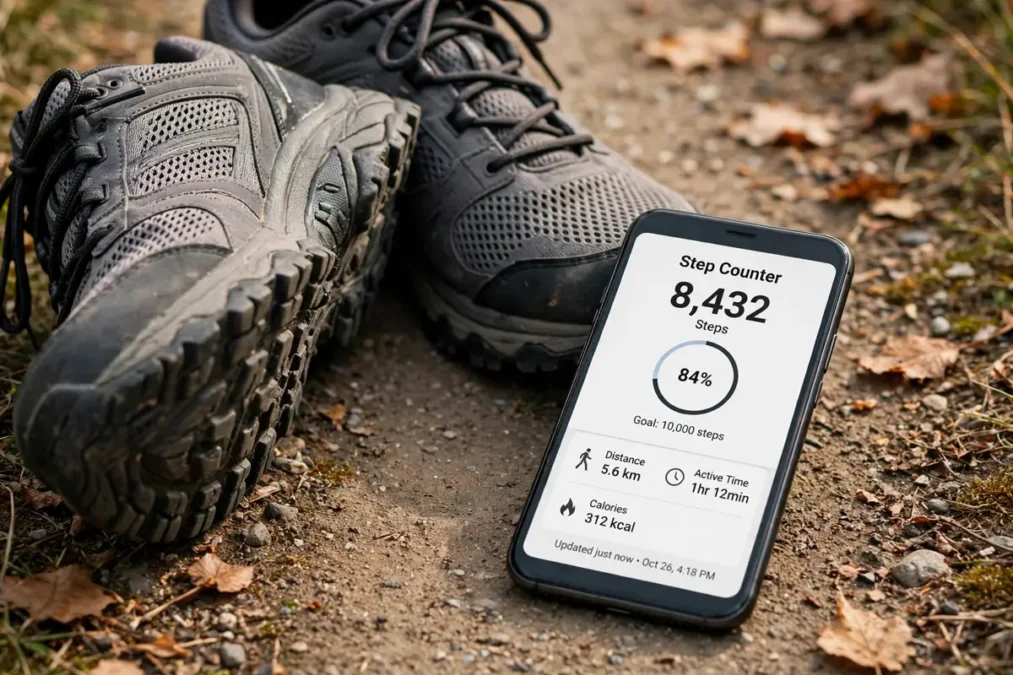
At a brisk pace of about three miles an hour, which the NHS uses as its definition of brisk walking, covering the four point two miles of an average ten thousand steps takes roughly eighty-five minutes, or just under an hour and a half. At a more leisurely two miles an hour, the same distance takes a little over two hours, which sounds like a lot until you remember that most people do not walk ten thousand steps in one go. Spread across a whole day, through commuting, errands, chores and a deliberate walk, ten thousand steps usually accumulate in several shorter bursts rather than a single long outing.
That is also how the NHS suggests building activity into your day, because a brisk ten-minute walk counts towards the recommended one hundred and fifty minutes of moderate activity per week for adults, and several ten-minute bursts add up surprisingly quickly. If you walk part of your commute, take the stairs instead of the lift, and add a twenty-minute walk at lunchtime, you may already be most of the way to ten thousand steps before the evening. For people who sit at a desk all day, setting a reminder to walk for ten minutes every couple of hours is often more effective than relying on one heroic evening walk.
How Many Calories Do 10,000 Steps Burn?
As a rough guide, ten thousand steps burn somewhere around four hundred to five hundred calories for an average-weight adult, although the true figure depends on your body weight, your pace, and the terrain. Heavier people burn more calories per step because they move more mass with every stride, faster walkers burn more per minute because their muscles work harder, and hills add a significant extra cost compared with flat pavements. A lighter person strolling on the flat might burn closer to three hundred calories for ten thousand steps, while a heavier person walking briskly uphill could burn well over five hundred, so any single number should be treated as an estimate.
It is worth keeping those calories in perspective, because four hundred to five hundred calories is roughly a fifth of a typical adult’s daily energy needs, which makes walking a genuinely useful part of weight management without being a magic solution on its own. Walking also burns calories in a way that is easy to sustain, because it does not leave you ravenous in the way intense exercise sometimes does, and it can be done every day without recovery time. If weight loss is your goal, combining a daily step target with attention to food intake will achieve far more than either approach alone, and a tracker that estimates calories should be treated as a guide rather than a precise measurement.
Is 10,000 Steps a Day the Right Goal?
The ten thousand steps figure traces back to a Japanese pedometer marketing campaign in the nineteen sixties, when the name of a step counter translated roughly as the ten thousand steps meter, and it stuck because it is memorable rather than because researchers discovered a magic threshold. Modern research generally shows that health benefits rise steeply as inactive people start moving more, and continue to improve up to around seven to nine thousand steps a day for many adults, after which the extra benefit of each additional thousand steps becomes smaller. That does not make ten thousand a bad goal, but it does mean that someone walking seven thousand steps a day is already gaining most of the benefit, and should not feel like a failure for missing a round number.
The NHS guidance is more useful than any single step target, because it recommends at least one hundred and fifty minutes of moderate-intensity activity per week for adults, and brisk walking counts towards that total. A brisk ten-minute walk, repeated through the week, is a realistic building block, and the NHS Active 10 app is designed around exactly that idea, tracking brisk minutes rather than steps alone. The best daily goal is therefore the one you will actually keep: if ten thousand steps motivates you, keep it, but if it feels punishing, a smaller target walked briskly and consistently will do your health far more good than an ambitious target abandoned after a fortnight.
Conclusion
So, how many miles is 10000 steps? For most adults the answer is four to five miles, with four point two miles the best single figure for an average-height walker, and your own height and pace will shift that number up or down by a mile in either direction. The maths is simple once you know your stride length, and measuring it on a known route gives you a personal conversion that beats any generic table. Whether you walk for fitness, for weight management or simply to get around, knowing the distance behind your step count turns an abstract number into something you can actually plan around.
If you take one practical step from this guide, let it be this: measure your stride, check your tracker against a known mile, and then set a step goal you can sustain rather than one that impresses other people. Ten thousand steps is a fine ambition, but seven thousand brisk steps walked every day will do more for your health than ten thousand steps walked once and abandoned. Keep moving, keep it brisk, and let the miles take care of themselves.
Is 10,000 steps really 5 miles?
Ten thousand steps is five miles only for people whose stride is long enough to make it so, which generally means taller walkers or people walking briskly, because five miles requires an average stride of two point six four feet across all ten thousand steps. For a person of average height walking at an everyday pace, with a stride of around two point two feet, ten thousand steps come to roughly four point two miles, which is noticeably short of five. The five-mile claim is therefore not wrong, but it is only true for a subset of walkers, and repeating it as a universal fact misleads shorter or slower walkers about their own achievements. That is why how many miles is 10000 steps has no single universal answer, even though four to five miles covers almost everyone.
If your tracker regularly shows five miles at ten thousand steps, that is a good sign that your stride is longer than average, which is common for taller people and for anyone who walks briskly with a confident stride. If it shows closer to four miles, that does not mean your tracker is broken or that you are doing something wrong, because it simply reflects a shorter stride. The most reliable check is a measured route: walk a known mile, note your step count, and divide ten thousand by that count to find your own personal miles per ten thousand steps.
How many steps are in a mile?
For most adults walking at a normal pace, there are roughly two thousand to two thousand five hundred steps in a mile, with two thousand steps being a handy rule of thumb for taller walkers and two thousand five hundred for shorter walkers. That range follows directly from stride length: a mile is five thousand two hundred and eighty feet, so dividing it by a stride of two point six feet gives about two thousand and thirty steps, while dividing it by a stride of two point one feet gives about two thousand five hundred and fourteen steps. The commonly quoted figure of two thousand steps per mile is therefore accurate for taller people but optimistic for shorter ones.
Pace changes the count as well, because a brisk walker takes longer strides and therefore fewer steps per mile, while a slow walker takes shorter strides and more steps. Running cuts the count further, since running strides are longer, which is why a runner might cover a mile in roughly one thousand five hundred steps. If you want an exact figure for yourself, walk a measured mile at your usual pace and count your steps, or check your tracker after a known route, and use that personal number for all future conversions.
Do shorter people cover fewer miles in 10,000 steps?
Yes, shorter people generally cover fewer miles in ten thousand steps, because stride length is closely related to leg length, and leg length is closely related to height. A person who is five feet tall, with a stride of around two feet, covers roughly three point eight miles in ten thousand steps, while a person who is six feet tall, with a stride of around two point six feet, covers roughly four point nine miles, which is a difference of more than a mile for the same number of steps. That gap is a matter of geometry rather than fitness, and it is why step-count comparisons between people of very different heights are not a fair measure of who walked further.
Shorter walkers do compensate to some extent by taking steps more quickly, which is why their cadence, or steps per minute, tends to be higher at the same speed, but cadence does not change the distance covered per step. If you are shorter and your step count looks high compared with a taller walking partner, that is normal and expected, and it does not mean you are working less hard. What matters for health is the time spent moving briskly and the total activity across the week, not whether your ten thousand steps happened to cover four miles or five.
How can I track my steps accurately?
The most accurate everyday method is a phone or wrist-worn tracker that you wear consistently, because accuracy depends far more on consistent wear and a calibrated stride length than on the price of the device. Wear the tracker in the same place each day, usually on your wrist or in a pocket, and enter your height correctly when you set it up, since most apps estimate your stride from your height. If your app allows it, enter a measured stride length instead, which you can find by walking ten normal steps, measuring the distance, and dividing by ten, because that personal figure immediately improves every distance estimate the app makes.
You can also check your tracker against reality by walking a route of known distance, such as a measured mile in a park or a running track, and comparing the step count with what the maths predicts. The NHS Active 10 app is a useful cross-check, because it focuses on brisk minutes rather than steps alone, and it can confirm whether your walking is fast enough to count as moderate activity. If your tracker disagrees wildly with a known route, check that it is worn snugly, that your height and stride settings are correct, and that you are not counting steps from activities such as cycling or driving, which some devices mistake for walking.